

CERN and Mistral Want to Build AI That Understands Particle Collisions
The Geneva-based CERN and French AI developer plan to train a model on billions of simulated particle collisions. Their collaboration could advance scientific research while giving Europe an opportunity to develop AI technology for highly specialised fields.
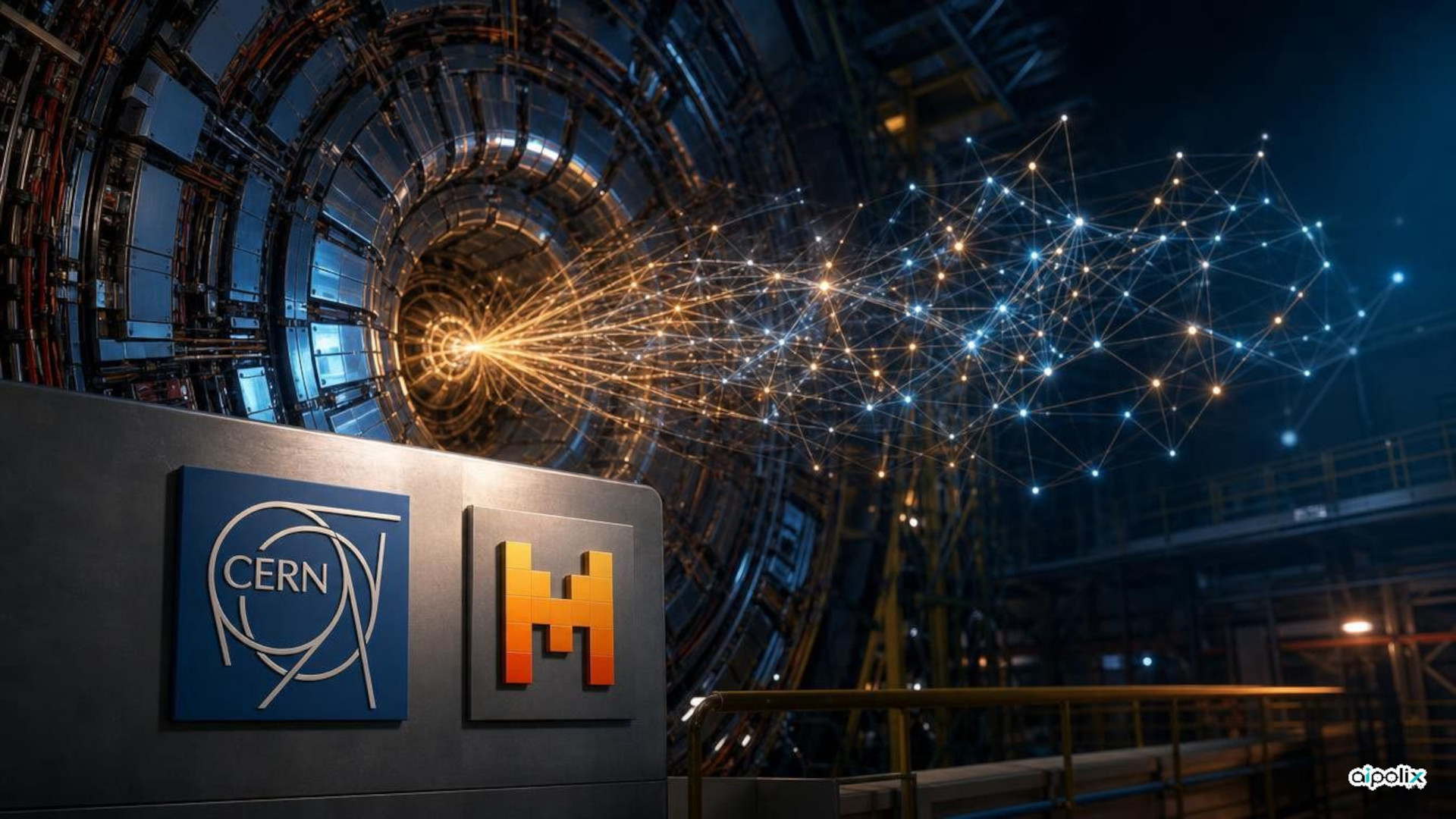
CERN and French artificial intelligence company Mistral AI announced a partnership on 15 October 2026 to develop a foundation model for particle physics, bringing together one of the world’s largest scientific datasets and European expertise in training advanced AI systems.
The proposed Large Physics Model will learn from billions of simulated proton-proton collisions at CERN’s Large Hadron Collider (LHC), near Geneva. Its intended applications range from identifying particles and reconstructing collisions to detecting unusual signals that could warrant further scientific investigation.
The two organisations have signed a statement of intent to establish a long-term collaboration. They have not announced a development budget, completion date or performance results for the proposed model.
For Mistral, the project extends its work beyond general-purpose AI into a field where scientific expertise and specialised data matter as much as computing power. It also provides a prominent test of whether Europe’s research institutions can help its AI companies develop capabilities that are difficult to reproduce without access to the same scientific infrastructure.
Why CERN Needs a Different Kind of AI
The Large Hadron Collider accelerates beams of protons around a 27-kilometre underground ring before bringing them into collision. Detectors record the resulting signals, which physicists use to reconstruct the particles produced and investigate the fundamental properties of matter.
Turning those signals into scientific information requires considerable computing power. Researchers must identify particle tracks, measure energy deposits and determine which detected signals belong to particular particles before analysing the underlying physical processes.
CERN already uses machine learning in this work, but much of the reconstruction process relies on a succession of specialised algorithms, each developed to perform a particular task.
The proposed Large Physics Model would attempt to learn relationships across several stages of this process, allowing researchers to adapt a single pretrained system to different applications rather than developing independent models for every problem.
The approach draws on the foundation-model technology behind modern language AI. Large language models learn statistical relationships from enormous collections of text and can subsequently perform tasks ranging from translation to document analysis. CERN and Mistral intend to apply a comparable training approach to simulated particle-collision data.
Its success will depend on whether the model learns the underlying physical relationships accurately enough to support scientific analysis. A plausible prediction is insufficient when researchers need precise measurements and reliable estimates of uncertainty.
CERN’s CMS collaboration has already demonstrated that machine learning can reconstruct particle collisions more quickly and precisely than traditional methods in a research setting. In February 2026, the collaboration reported results from a machine-learning approach to full particle reconstruction, providing evidence that AI can improve established analysis techniques.
The new partnership aims to develop a model with broader capabilities, building on such advances rather than beginning from an entirely untested approach.
Preparing for Ten Times More Collisions
CERN has accumulated approximately one exabyte of experimental data from the LHC, equivalent to one million terabytes. Managing and analysing that volume has required an extensive international computing infrastructure, connecting research institutions and data centres across the world.
The challenge will grow as CERN completes the High-Luminosity LHC upgrade.
Scheduled to begin operation around 2030, the upgraded accelerator aims to deliver approximately ten times more collisions over its operating lifetime than the LHC’s original design performance. The additional data will allow scientists to examine the Higgs boson in greater detail, investigate rare processes and search for evidence of physics beyond current theories.
More collision events also mean more information to reconstruct, process and store. Improvements in computing efficiency could therefore influence how much scientific work researchers can complete with the available infrastructure.
A foundation model capable of handling several reconstruction tasks may help simplify parts of the analysis process, although the partnership has not established whether it will reduce computing costs or outperform existing software across all applications.
Researchers will also have to establish how reliably a model trained on simulated collisions performs when processing measurements from real detectors. Simulations approximate physical processes and detector responses, but experimental data inevitably contain additional complexities.
CERN’s existing scientific methods provide a demanding basis for evaluating those results. New algorithms must be tested against established measurements, validated by researchers and examined for systematic errors before their findings can contribute to scientific conclusions.
Why Mistral Is Expanding Into Scientific AI
Mistral has built much of its reputation on large language models, coding systems and enterprise AI products. The CERN collaboration gives the Paris-based company an opportunity to apply its model-training expertise to scientific data that differ substantially from ordinary text, images or business documents.
Its wider product development already extends into specialised forms of information processing. On 15 October, the same day as the CERN announcement, Mistral introduced Timestral, a family of foundation models designed to forecast time-series data.
Such models learn from sequences of numerical observations, with potential applications in areas that depend on forecasting and detecting patterns in changing data.
CERN’s particle-collision research presents another technical challenge. The model must learn relationships between detector readings and physical events, while allowing scientists to evaluate whether its output agrees with known principles and experimental observations.
Mistral has not indicated that the Large Physics Model will become a commercial product. Nor have the partners disclosed its eventual licensing arrangements or whether trained model weights will be made publicly available.
The company’s involvement nevertheless reflects a wider shift in AI development towards models designed for particular categories of work. Training systems on specialised data can be attractive where organisations need greater precision, technical understanding or control than general-purpose models currently provide.
For European AI developers, scientific collaborations may also offer access to expertise and datasets that cannot be assembled through ordinary commercial data collection.
The Commercial Significance for European AI
Europe’s AI industry competes with American technology companies that have substantial advantages in investment, computing infrastructure and access to commercial customers. Trying to match their spending on general-purpose models is consequently an expensive proposition.
Scientific and technical applications present a different set of competitive conditions. Research institutions, hospitals, financial businesses and engineering organisations possess specialised information, established methods and detailed knowledge of the problems they need to solve. AI developers working with these organisations can train and evaluate systems for tasks that general-purpose models may not handle adequately.
CERN offers an unusually demanding environment for this work. Its datasets are extensive, its computing requirements are substantial, and scientists assess algorithms against rigorous experimental standards.
The resulting research may contribute to techniques that other scientific fields can adapt, particularly where large datasets must be interpreted accurately and efficiently. CERN and Mistral have identified broader scientific applications as a longer-term ambition, although neither has announced specific projects outside high-energy physics.
Scientific success would not automatically translate into commercial demand. A model developed for particle-collision reconstruction cannot simply be transferred to a pharmaceutical laboratory or financial institution without further research, appropriate training data and validation.
Europe’s potential advantage lies in combining specialist research with AI engineering, then demonstrating that the resulting systems perform tasks that customers or scientific institutions cannot accomplish as efficiently with existing software.
For Mistral, that would provide another route to establishing its technical capabilities alongside its enterprise AI business.
What the Partnership Has to Prove
The first measure of progress will be whether CERN and Mistral can develop a model that performs several scientific tasks accurately enough to be useful to researchers.
Its ability to reconstruct collisions, identify particles and detect unusual events will need to be assessed against existing reconstruction software and specialist machine-learning systems.
Computing efficiency will also matter. Training a large model can require substantial resources, and using it repeatedly across millions of collision events may carry significant operating costs. A shared foundation model will need to justify those costs through performance, versatility or reductions in other parts of the analysis process.
The partners have also expressed an ambition to make AI capabilities available to the wider physics community. The practical arrangements for sharing models, software or research results remain to be announced.
CERN has a long history of developing technology that subsequently finds applications beyond particle physics, including the World Wide Web and advances in scientific computing. Whether the latest collaboration produces similarly transferable methods will depend on the research itself.
With the High-Luminosity LHC approaching operation around 2030, the immediate priority is to help physicists process an expanding volume of experimental information. The partnership gives Mistral access to a demanding scientific problem and provides CERN with expertise in large-scale AI training.
Its broader significance for Europe’s technology industry will become clearer when the proposed model begins producing measurable results.
Exporis Insight: How European AI Companies Can Demonstrate Specialist Expertise
The CERN–Mistral collaboration illustrates an opportunity for European AI developers working in specialised markets. Companies selling AI to financial institutions, healthcare providers, scientific organisations or other professional customers need to show how their technology performs on the problems those customers encounter.
Explain the specific application. Product communications should identify the task the model performs, the data it requires and how it fits into an existing process. Descriptions of model size or general intelligence offer limited guidance to customers evaluating a particular business application.
Publish evidence from testing. Technical buyers need to understand the benchmarks, datasets and operating conditions behind performance claims. Suppliers should distinguish independently verified results from internal tests and explain where their systems still require human oversight.
Use partnerships to demonstrate technical capability. Research collaborations and customer projects can provide evidence of specialised expertise when companies explain the work undertaken, their contribution and the results achieved. An announcement alone cannot establish that the technology performs better than competing products.
Adapt communications to purchasing decisions. Engineers and technical specialists assess accuracy, integration and reliability, while business executives examine implementation costs, security requirements and the expected operational benefits. Marketing materials need to address both groups without sacrificing technical precision.
Exporis supports technology businesses with specialist content, product positioning and digital communications. For AI providers entering European markets, documenting technical performance and explaining its commercial application can help prospective customers judge whether a product deserves further evaluation.