


The Marketing Bible Hidden Inside The Best Business Books
Most businesses do not have a marketing problem in the way they think they do. They do not need another caption or another forced attempt to “show up consistently” online.
What they usually need is a clearer answer to older questions. What are we really selling? Why should anyone believe us? What do we do better than the alternatives? Who are we not trying to serve? What kind of reputation are we building when nobody is ready to buy yet?
These questions sit underneath marketing, but they are rarely solved by marketing activity alone. They are business questions. That is why some of the most useful marketing lessons are not found in social-media manuals or growth-hacking playbooks. They are hidden inside books about entrepreneurship, leadership, culture, negotiation, innovation, money, creativity and long-term company building.
For this piece, our team used AI as a reading aid to summarise and compare ideas from well-known business books, including What They Don’t Teach You At Harvard Business School, Zero To One, Good To Great, Creativity, Inc., No Rules Rules, Rich Dad Poor Dad und The 100-Year Life. The point was not to reduce these books into motivational quotes. It was to ask a more practical question: what do their strongest ideas teach businesses about marketing, brand and online presence now?
The answer is surprisingly direct. Good marketing is not decoration. It is disciplined business thinking made visible.
Start With Difference, Not Content
The most common mistake in modern marketing is beginning with output. A business asks what to post on LinkedIn, how often to publish on Instagram, whether it needs a newsletter, what its SEO keywords should be, or whether the founder should become more visible.
Those are useful questions, but they come too late.
Peter Thiel’s Zero To One is usually discussed as a book about start-ups and monopolies. Its more useful marketing lesson is about difference. Thiel argues that lasting companies do not win by competing harder inside an existing category. They create or discover a position that others have missed. The original article summarising the book highlights the importance of differentiation, timing, long-term thinking and building something meaningfully distinct rather than merely joining the competition.
That idea is brutally relevant to branding. Most businesses are not under-marketed. They are under-differentiated.
They look similar, sound similar and make the same claims: premium service, trusted partner, innovative solution, client-centric approach, bespoke strategy, measurable results. None of this is wrong. It is just not enough.
A useful brand begins with a sharper claim. Not “we help businesses grow”, but “we help Swiss family offices avoid expensive software mistakes”. Not “we create content”, but “we turn expert knowledge into articles that win trust before a sales call”. Not “we are a sustainable design studio”, but “we help yacht owners reduce interior waste without making the vessel feel less luxurious”.
The more specific the business, the easier the marketing becomes. The content calendar is no longer an obligation. It becomes a way to prove the position.
The Brand Is The Flywheel
Jim Collins’ Good To Great is often remembered for Level 5 leadership, the Hedgehog Concept and the flywheel. For marketers, the flywheel is the most valuable idea.
Collins argues that great companies do not usually become great through one dramatic move. They build momentum through consistent, disciplined effort in the same direction. The source summary describes the flywheel as cumulative effort that eventually produces breakthrough, and the Hedgehog Concept as the intersection of what a company can be best at, what drives its economic engine and what it is deeply committed to.
That is exactly how strong brands are built.
Most businesses treat marketing like a sequence of pushes: launch campaign, post more, run ads, update website, announce news, disappear, return with another campaign. The audience experiences this as noise, because the company keeps asking for attention without building memory.
A brand flywheel works differently. It repeats the same strategic proof from different angles until the market starts to associate the business with a specific kind of value.
For a boutique consultancy, that may mean publishing monthly analysis on one narrow problem. For a law firm, it may mean explaining regulatory change before competitors do. For a luxury interiors studio, it may mean showing the decision-making behind materials, suppliers, craftsmanship and longevity. For a political-communication expert, it may mean becoming the person who can explain difficult public issues with clarity and calm.
The point is not repetition for its own sake. It is accumulation.
A business does not become known because it posts often. It becomes known because it says something recognisable, useful and credible for long enough.
Marketing Is Sales Before The Sales Call
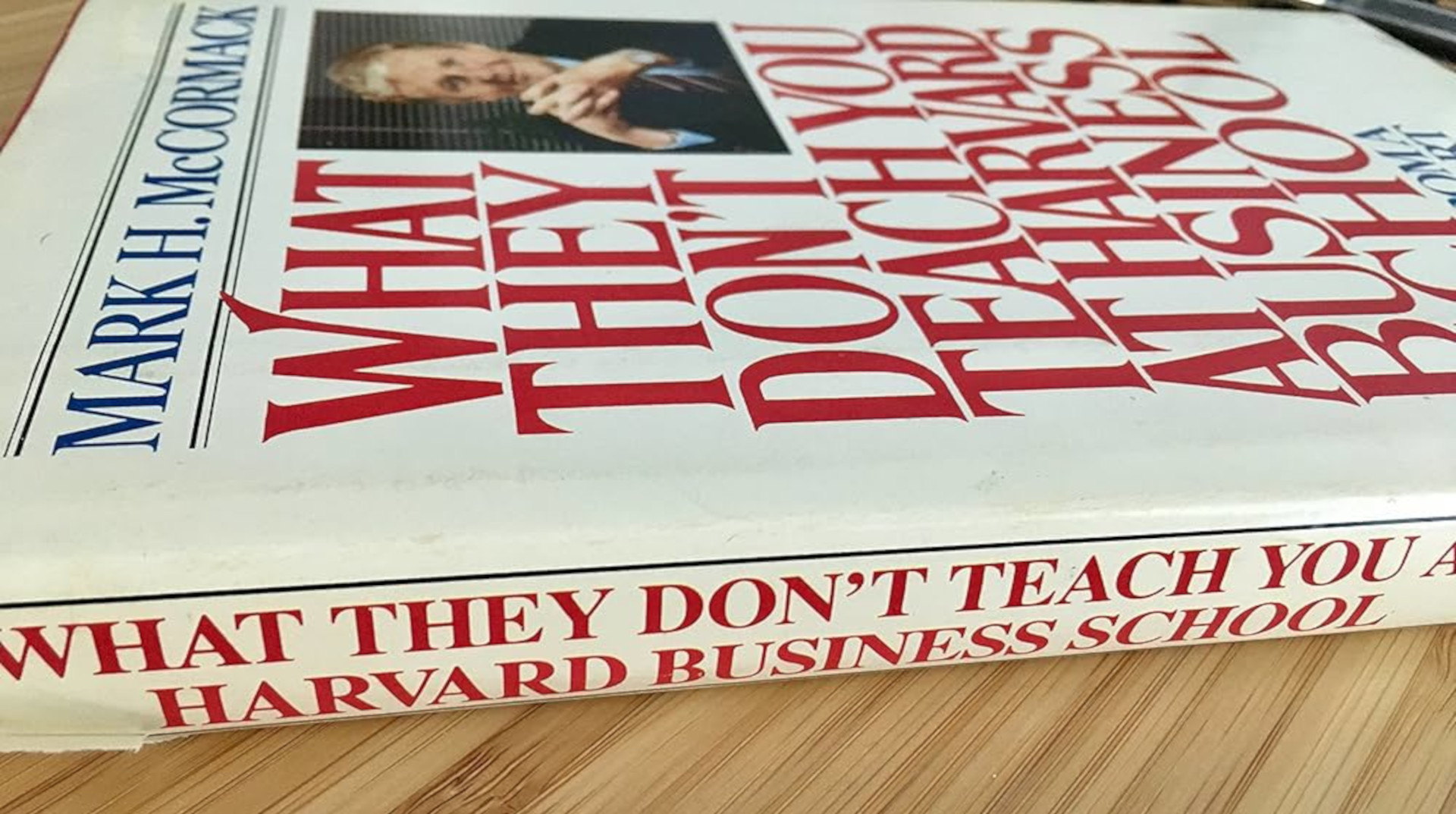
Mark McCormack’s What They Don’t Teach You At Harvard Business School is old, but its lessons have aged well because they are grounded in human behaviour. The original summary highlights street smarts, salesmanship, negotiation, time management, reputation, adaptability and learning from mistakes.
For modern businesses, the most important point is that salesmanship does not only belong to salespeople. It belongs to every public touchpoint.
Your website sells. Your founder’s LinkedIn sells. Your case studies sell. Your Instagram stories sell. Your speaking appearances sell. Your newsletter sells. Your job ads sell. Your refusal to answer a difficult question also sells, just in the wrong direction.
This does not mean every piece of content should be aggressive or promotional. The strongest marketing often sells by reducing uncertainty.
A potential client wants to know: Do they understand my problem? Have they solved this before? Do they speak my language? Are they serious? Are they discreet? Are they fashionable but shallow, or commercially useful? Are they too junior? Too expensive? Too generic? Too slow? Too risky?
Good online presence answers these questions before the person asks.
This is why businesses should stop thinking of content as “visibility” only. Visibility is not enough. A random viral post may create attention without trust. A beautiful Instagram grid may create taste without conversion. A clever LinkedIn opinion may create reach without authority.
The better question is: what would a serious buyer need to see repeatedly before believing we are the right choice?
That is the content strategy.
Culture Shows Up In The Brand
A brand cannot consistently say what the company does not live.
That is the marketing lesson inside No Rules Rules, the Netflix culture book by Reed Hastings and Erin Meyer. The source summary highlights Netflix’s emphasis on transparency, context rather than control, high talent density, adaptability and experimentation.
Whether one likes the Netflix model or not, the broader point is useful: internal culture eventually becomes external reputation.
If a company claims to be innovative but punishes employees for speaking honestly, the marketing will become hollow. If a business claims to be premium but treats delivery as an afterthought, clients will feel the gap. If a founder posts about thought leadership but the company has no real point of view, the content will sound manufactured. If a consultancy promises strategic clarity but its own website is confused, the contradiction becomes visible.
Social media makes this harder to hide. People now meet a business through many fragments: founder posts, employee comments, podcast appearances, office photos, client events, press quotes, website copy, Glassdoor reviews, hiring posts and informal conversations.
The brand is no longer only what the company publishes. It is what leaks through.
That is why marketing leaders should care about culture, not because it sounds noble, but because inconsistency is expensive. A company can spend heavily on brand positioning and still lose trust through unclear leadership, poor service or staff who do not understand what the company stands for.
The best online presence is not invented by the marketing team. It is extracted from a business that knows itself.
Creativity Needs A Feedback System
Ed Catmull’s Creativity, Inc. is one of the most useful books for any business that depends on creative output. Its central lesson is not “be creative”. It is that creativity needs conditions: candour, iteration, psychological safety, good leadership and honest feedback. The source summary describes Pixar’s Braintrust as a mechanism for candid, constructive criticism used to refine work, and emphasises that failure is part of the creative process.
This is where many marketing teams fail.
They generate ideas, but they do not build a serious feedback system. Campaigns are judged by internal preference. Content is approved by the most senior person in the room. Social posts are watered down until nobody can object to them. Brand language becomes safer, flatter and less memorable because everyone edits risk out of it.
A business that wants better marketing needs a better critique culture.
The question should not be “do we like this?” It should be: Does this make the brand more distinct? Is the claim credible? Would the target client care? Is the evidence strong enough? Is the tone right for the category? Is this too vague? Is it brave in a useful way, or merely noisy? What would a sceptical buyer think? What should we remove?
AI makes this even more important. McKinsey argues that the future of marketing will be shaped by AI capabilities across insights, creativity, personalisation, agentic commerce and orchestration. In practice, this means businesses will be able to produce far more marketing material, far faster.
That makes judgement more valuable, not less. When output becomes abundant, editing becomes a strategic function.
Your Online Presence Is An Asset, Not An Expense
Rich Dad Poor Dad is not a marketing book, and not all of its financial advice should be accepted uncritically. But one idea travels well: the difference between assets and liabilities. The original summary explains Kiyosaki’s argument that assets are things that generate income, while liabilities drain resources.
Apply that to marketing.
Many businesses treat their online presence as a cost: website cost, agency cost, content cost, design cost, ad cost. That is often because the work has been designed as decoration rather than as an asset.
A strong article library is an asset if it answers the questions serious clients search for before they buy. A founder’s LinkedIn presence is an asset if it builds authority, trust and deal flow. A newsletter is an asset if it keeps the business in the mind of future buyers. A case-study archive is an asset if it shortens sales cycles. A well-structured website is an asset if it explains value clearly and converts qualified interest.
The opposite is also true. A vague website is a liability. A social-media feed that makes the company look less serious is a liability. A blog full of generic AI-written posts is a liability. A founder who posts constantly but without judgement can become a reputational liability.
The goal is not to “do marketing”. The goal is to build public proof that keeps working when the team is not in the room.
Social Media Should Prove The Business, Not Perform Personality
The rise of founder-led marketing has created a strange pressure. Every entrepreneur is told to be visible, vulnerable, opinionated, authentic and consistent. Some of that is useful. Much of it is exhausting.
The business-book lesson is simpler. Reputation matters.
McCormack’s emphasis on brand-building and practical people skills is still relevant here. Reputation is built through behaviour, judgement and how others experience you, not only through what you say about yourself.
For businesses, this means social media should not become theatre. It should make the company easier to trust.
A good founder profile does not need to share everything. It needs to show how the founder thinks. What does she notice before others? What does he explain clearly? What does the team believe that the market misunderstands? What mistakes has the business learned from? What does good work look like behind the scenes? What standards does the company refuse to lower?
This is especially important in professional services, luxury, finance, consulting, technology, healthcare, education and B2B markets. Buyers are not looking for entertainment only. They are looking for competence signals.
A polished online presence should therefore include four layers: expertise, proof, personality and access. Expertise shows what the business knows. Proof shows what it has done. Personality makes it human. Access makes it easy to take the next step.
Most brands overdo one layer and neglect another. They post expertise without proof, personality without substance, proof without warmth, or access without trust.
The balance is the brand.
Long-Term Thinking Is A Marketing Advantage
The 100-Year Life argues that longer lives will require continuous learning, adaptability and multiple career phases. The source summary highlights flexibility, lifelong education, social connections and the need to rethink traditional life structures.
For businesses, the equivalent is long-term brand adaptability.
Marketing platforms change. Search changes. Social algorithms change. AI search is changing how people discover companies. Deloitte Digital’s 2025 marketing trends emphasise omnichannel experiences and the use of AI-driven automation for personalisation, service and localisation at scale. McKinsey similarly argues that marketing is moving from campaign-based activity towards continuous growth systems shaped by AI-enabled insight, creativity, personalisation and optimisation.
This means businesses should stop building online presence around platform tricks.
A company that depends entirely on Instagram reach is fragile. A company that depends entirely on Google rankings is fragile. A company that depends entirely on paid ads is fragile. A company that depends entirely on the founder’s personal account is fragile.
The stronger model is a connected visibility system: website, email list, search, social, events, media, partnerships, client referrals, thought leadership and direct relationships. Each part should reinforce the same reputation.
The platforms will keep changing. The brand memory should not.
The Marketing Bible For Businesses
If the lessons from these books were turned into a practical marketing bible, it would not begin with content formats. It would begin with discipline.
First, know what makes the business different. If the answer is not specific enough to exclude some people, it is probably not a position.
Second, build the flywheel. Choose a small number of messages, proof points and topics that you can own over time. Repeat them with intelligence, not boredom.
Third, sell before the sales call. Use content to answer buyer doubts, explain your standards and make trust easier.
Fourth, make culture visible. Do not market values the company does not practise.
Fifth, create a feedback system. Better marketing comes from better critique, not only better ideas.
Sixth, treat online presence as an asset. Every article, post, case study, email and landing page should increase trust or reduce friction.
Seventh, use AI carefully. Let it accelerate research, summarise information, generate options and improve workflow, but do not let it replace judgement, evidence or voice.
Eighth, build for longevity. Do not chase every platform trend at the expense of a coherent reputation.
This is not glamorous advice. But it is the difference between businesses that make noise and businesses that become known.
AI Can Help, But It Cannot Decide Who You Are
AI is changing marketing quickly. It can summarise books, generate campaign ideas, draft posts, analyse competitors, personalise content and produce endless variations. That is useful. It is also dangerous if the business has no strategy.
AI can make a clear brand faster. It can make a confused brand louder.
This is why the old business books still matter. They remind us that marketing is not fundamentally about tools. It is about difference, discipline, salesmanship, culture, creativity, assets, learning and long-term trust.
The businesses that use AI well will not be the ones that publish the most. They will be the ones that know what they stand for before they ask the machine to help them say it.
The best marketing still begins before the post. It begins with a business worth remembering.